Ohio Abandoned Vehicle Title Process for Towing Companies & Repair Garages
Two months. That is how long the car has been sitting in the corner of the lot. The repair is finished. Storage fees keep climbing. The owner stopped responding weeks ago, and every attempt to reach them has gone nowhere. The instinct is to fill out the paperwork, pay the filing fees, and reclaim the space.
Filing without completing every required step, including one that most procedural guides leave out entirely, can expose a repair garage, towing company, or storage facility to federal liability that far outweighs the value of any single vehicle.
Ohio law does provide a clear administrative path to obtain title on an unclaimed vehicle under Ohio Revised Code 4505.101. That path has mandatory steps in a specific order, and the most consequential comes before the first form is touched.
Who Can Use Ohio’s Abandoned Vehicle Title Process
ORC 4505.101 applies to three categories: repair garages where the owner never returned after a completed repair, places of storage where a motor vehicle has remained unclaimed past the agreed term, and towing companies operating under Ohio Revised Code 4513.601.
Private property owners do not qualify. They must contact local authorities, and if law enforcement declines, petition the court for a court ordered title.
The $3,500 threshold is the wholesale price of the vehicle minus agreed upon repair costs and reconditioning, not the retail figure. Vehicles above $3,500 use the court ordered route.
Repair garages and storage facilities can proceed after the vehicle has remained unclaimed for 15 days following the completed repair or agreed storage term. Towing companies wait 60 days from the earliest required notice.
Before anything else, there is one determination that shapes the entire process, and it has nothing to do with the vehicle itself.
Why Military Status Verification Comes First
Every procedural guide covers ORC 4505.101. Almost none mention the federal check that determines which legal path is available.
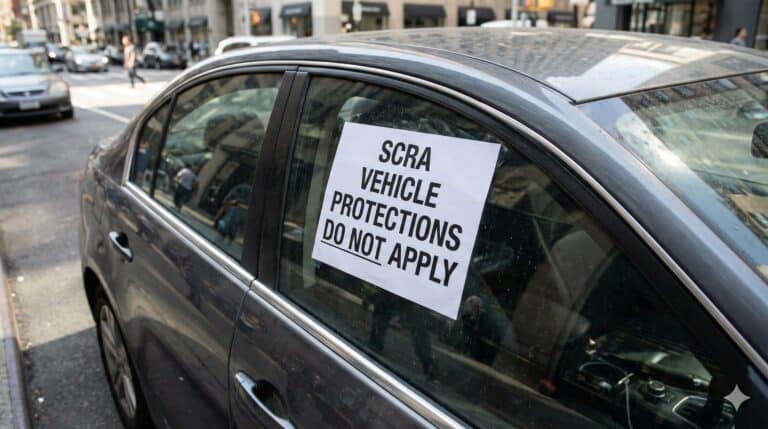
Under 50 U.S.C. 3958, the Servicemembers Civil Relief Act prohibits any towing company, storage facility, or lienholder from enforcing a possessory lien on a servicemember’s vehicle without a court order, during active duty, and for 90 days after. The prohibition applies automatically, and the owner does not need to invoke it.
Skipping this check can convert a routine title transfer into an unlawful repossession under federal law. The S&K Towing case documents exactly that outcome. Military status verification through SCRACVS queries the Defense Manpower Data Center and returns one of two results: the owner is not a servicemember and ORC 4505.101 can proceed, or the owner is on active duty, and a court order is required.
With military status confirmed, the ORC 4505.101 process can move forward in the correct order.
Step by Step: The Ohio Abandoned Vehicle Title Process Under ORC 4505.101
ORC 4505.101 establishes a specific sequence, and the sequence matters. Each step creates the legal foundation for the one that follows. Completing them out of order renders the affidavit invalid and forces the facility to start over.
Step 1: Confirm the vehicle qualifies
The vehicle must have remained unclaimed for the required period, 15 days for repair garages and storage facilities after the completion of the requested repair or agreed storage term, and 60 days from the date of the earliest notice for towing companies.
The vehicle value, calculated using the wholesale formula, must be under $3,500. For vehicles that are inoperable and valued under $1,500, Ohio provides a separate salvage process using Form BMV 4209 that may apply instead of the standard title route.
Step 2: Run the BMV title search
Ohio law mandates a record search to identify the last known owner and any lienholders before any notice is sent. Businesses use BMV Form 1173 to conduct this search through the Bureau of Motor Vehicles. No affidavit can be executed or filed until this search is completed. That is not a procedural preference. The statute makes it a prerequisite, and an affidavit filed without a completed search is invalid.
Step 3: Send a certified notification to the owner and all lienholders
The search results determine who receives notice. Notification must reach the last known address of both the vehicle owner and any lienholder through certified or express mail with return receipt requested, or through a commercial carrier that requires a signed receipt.
The first notice must go out within five business days of receiving the BMV search results. If the car remains unclaimed, a second notification follows 30 days after the first notice date.
When the person who originally requested the repair or agreed to storage is not the titled owner or a lienholder, the facility must also notify the county sheriff or the local law enforcement agency serving the area where the facility is located.
Step 4: Wait for the required 60-day period
After the earliest required notice is confirmed by a signed receipt or notification of failed delivery, businesses must wait 60 days before taking any further action. The clock starts on the date of the earliest notice, not the date the facility decided to pursue title, and not the date the vehicle first arrived. Starting the count from the wrong date is one of the most common errors in the Ohio abandoned vehicle title process, and it produces an affidavit that will not hold up.
Step 5: Execute the Unclaimed Motor Vehicle Affidavit
An agent of the repair garage or storage facility completes BMV Form 4202, the Unclaimed Motor Vehicle Affidavit, affirming that all requirements under ORC 4505.101 have been satisfied.
The affidavit must state the vehicle’s value, the length of time the motor vehicle has remained unclaimed, that certified notice went to the titled owner and any lienholder, and that a BMV title search was completed before notification.
The facility agent must also present BMV Form 2433 as photo identification at the time of filing. Executing the affidavit before the BMV search is done voids the document entirely.
Step 6: File with the Clerk of Courts and pay the fees
The completed affidavit goes to the clerk of courts in the county where the garage or storage facility is located. The facility pays applicable titling fees plus the base value of the vehicle minus actual expenses incurred, including completed repair costs and storage fees for the period the vehicle was held without payment.
Once the clerk receives the proper documents and funds, a certificate of title issued free and clear of all liens and encumbrances transfers ownership to the garage or facility. Any prior lien holder recorded in the BMV search loses their claim at that point, provided all notification steps were followed correctly.
The affidavit step catches many businesses off guard because the value calculation is more specific than it first appears.
What Happens When There Is a Lienholder on the Vehicle
A BMV title search that returns an active lien adds a party requiring the same certified notification as the titled owner, on the same timeline and delivery method.
If the lienholder responds within the 60-day window and claims the vehicle, the ORC 4505.101 path closes, and the facility’s claim ends. If they do not respond or certified mail returns undelivered, the process continues through filing.
The SCRA dimension is where most facilities miss something. A lienholder could be a bank, a credit union, or a dealer holding a lien on a vehicle whose owner is on active military duty. SCRA protection follows the vehicle owner, not the lienholder’s knowledge of that status. Financial institutions use a military verification service before authorizing any enforcement action because federal liability does not depend on intent.
Even with every step followed correctly, a handful of recurring errors send businesses back to the beginning.
Common Mistakes That Delay or Invalidate the Ohio Abandoned Vehicle Title Process
These errors are costly and avoidable, and all of them show up regularly in filings that do not go through.
1. Skipping the BMV title search before sending notice
ORC 4505.101 explicitly prohibits executing or filing the affidavit before the title search is completed. Businesses that send notice first and run the search after creating an ordering defect that invalidates the affidavit. There is no corrective path. The search must precede the first notification, without exception.
2. Using the wrong delivery method
Regular first-class mail establishes nothing. Ohio law requires certified or express mail with return receipt requested, or a commercial carrier service that requires a signed receipt. A notice sent through any other method does not satisfy the statute, does not start any waiting period, and requires the business to resend through the correct channel before the clock begins.
3. Starting the 60-day waiting period from the wrong date
The period runs from the date of the earliest required notice, confirmed by signed receipt or notification of failed delivery. Facilities that start counting from the date the vehicle arrived, the date the repair was completed, or the date they decided to file end up submitting the affidavit before the required window closes. That produces a filing the clerk cannot legally accept.
4. Miscalculating vehicle value
Using the retail price or trade value instead of the wholesale minus repair formula leads businesses to apply under ORC 4505.101 for vehicles that actually require the court-ordered process. The clerk will catch the discrepancy, but only after the facility has already invested time, postage, and filing fees in the wrong path.
5. Filing in the wrong county
The affidavit goes to the clerk of courts in the county where the garage or storage facility is located. Filing in the county where the vehicle was registered or where the owner lives is a procedural error that requires the entire filing to be refiled in the correct jurisdiction.
6. Skipping military status verification
Federal law does not have a knowledge exception. If the vehicle owner or a lienholder’s customer is on active duty, SCRA protection applies regardless of whether the facility knew about the servicemember’s status. Every ORC 4505.101 step a business completes without verifying military status first can be rendered invalid by a protection the owner never needed to invoke.
For estate situations, out-of-state vehicles, and abandoned cars on private property, the process carries a few additional considerations worth knowing before any paperwork is submitted.
Special Situations: Deceased Owners, Out-of-State Vehicles, and Private Property
A titled owner who is deceased requires notification to the estate. A death certificate confirms that the owner is no longer living, but it does not replace or satisfy the notification requirement. The estate must still receive a certified mail notice through the proper channel.
When the estate is in probate or the family has not yet opened an estate account, the correct documentation path gets more complex. An attorney with experience in Ohio title law can advise on what additional documents the clerk requires and whether the court-ordered title route becomes the cleaner option in that situation.
Vehicles registered in another state add a search layer that the BMV Form 1173 alone does not cover. If a car carries an out-of-state registration, a title search in that state’s records may be required alongside the Ohio BMV search to identify all lienholders and confirm the owner of record.
Local authorities and the Ohio State Highway Patrol may be involved to verify that the vehicle does not appear on a stolen vehicle report. Businesses that handle out-of-state vehicles regularly should consult a title attorney before filing to confirm which records are required for the affidavit to be complete.
Private property owners who cannot get law enforcement assistance face a different process altogether. Contacting local police is the required first step when a vehicle has been left on private property without permission. Some law enforcement agencies remove the vehicle directly. Others treat the situation as the property owner’s responsibility and decline to act.
When enforcement assistance is not available, the property owner must petition the court to establish ownership through the Court of Common Pleas, and military verification remains a required step before any enforcement or transfer action is taken on that path as well.
What Ohio Businesses Should Do Before Filing for an Abandoned Vehicle Title
The ORC 4505.101 process is reliable when followed correctly. Before filing, verify military status for the vehicle owner and any lienholder, confirm the vehicle value falls under $3,500 using the wholesale formula, complete the BMV title search, and confirm all notice periods have run.
Repair garages, towing companies, and storage facilities use SCRACVS military verification to confirm active duty status before any lien enforcement or title transfer. That check separates a routine title issuance from a federal compliance problem.
FAQs
How long does the Ohio abandoned vehicle title process take from start to finish?
In Ohio, obtaining a title for an abandoned vehicle requires that the vehicle be left unclaimed for 60 days at a storage or towing facility or repair garage from the date of the earliest confirmed notice. Add time for the BMV title search, the five-business-day window to send the first notice, and the affidavit preparation and filing, and the realistic timeline runs 75 to 90 days from the point a vehicle is flagged as unclaimed, assuming every step is completed correctly the first time.
What is the difference between how licensed businesses and private individuals obtain title for an abandoned vehicle in Ohio?
Licensed businesses, including repair garages, storage facilities, and towing companies, can use the administrative process under ORC 4505.101 if the vehicle is valued under $3,500 and the required steps are followed. Private individuals generally need a court-ordered title, obtained through the Court of Common Pleas, regardless of vehicle value.
The vehicle must remain unclaimed for 15 days after repairs or agreed storage, or 60 days from the date of the earliest notice for towing situations, before a licensed business can begin the title application process. Private property owners who cannot get local law enforcement assistance must also pursue the court-ordered route.
What forms are required for the Ohio abandoned vehicle title process?
A record search to identify the last known owner and any lienholders is conducted using BMV Form 1173. The core filing documents are the Unclaimed Motor Vehicle Affidavit, Form BMV 4202, and BMV Form 2433 for photo identification at the time of filing. For vehicles that are inoperable and valued under $1,500, a separate salvage process using Form BMV 4209 may apply instead of the standard title route.
What happens if the vehicle owner is on active military duty?
SCRA protection under 50 U.S.C. 3958 prevents any lienholder or tow and storage company from enforcing a possessory lien or transferring title without a court order during active duty and for 90 days after the servicemember’s duty ends. The ORC 4505.101 affidavit route is not available when the vehicle owner is on active duty. A Court of Common Pleas petition is required instead. This protection applies automatically without the servicemember needing to request it, which is why military status verification through a service like SCRACVS must happen before any notice is sent, not after the waiting period runs.