
Florida Abandoned Vehicle Title Process: The Complete Compliance Guide
An unclaimed vehicle has been sitting in your lot for 40 days. You have sent the notices. The registered owner has not responded. You are ready to schedule the auction.
There is one step Florida towing companies consistently skip, and it has cost some operators six figures in federal penalties. Before any public sale, you must verify whether the registered owner is on active military duty. The Servicemembers Civil Relief Act makes this a federal legal requirement. The Department of Justice treats violations as criminal matters and has sued Florida operators specifically for this failure.
Florida’s abandoned vehicle title process follows clear procedures under Florida Statutes. Most operators know those steps. What catches them is the requirement that lives outside state law, in federal statute, arriving at the exact moment operators believe the paperwork is already done. Getting every other step right and missing this one is what puts operators in front of a federal judge.
What Makes a Vehicle “Abandoned” Under Florida Law
Florida Statute §705.101 draws the legal line clearly. Any vessel or motor vehicle left on public property for more than 48 hours without being moved qualifies as an abandoned motor vehicle. On private property, the threshold extends to seven days without the property owner’s consent. The Florida Highway Patrol applies a stricter window on limited-access roadways. Any vehicle left there for six hours meets the definition.
The statute covers far more than passenger cars. Abandoned trailers, motorcycles, campers, RVs, mobile homes, boats, and trucks all qualify as abandoned property when they appear on public property in a wrecked, inoperative, or partially dismantled condition.
Antiques abandoned on public property carry no special exemption. Florida Statutes treats them identically to any ordinary abandoned motor vehicle. Such property includes any tangible personal property without an identifiable owner that sits in a condition lacking apparent intrinsic value sufficient to withstand normal exposure to the elements. When a law enforcement officer ascertains that an abandoned vessel or vehicle of such nature is present, the process starts.
Local governmental entities add a separate layer of authority. Tampa, Sarasota County, and other local governments can shorten abandonment windows through ordinance, sometimes applying timelines below the state threshold.
Who Has Authority to Handle Abandoned Vehicles in Florida
Not every party can initiate the abandoned vehicle process. A law enforcement officer holds primary authority: posting notice on the vehicle, notifying the registered owner, and triggering the removal sequence. A code enforcement officer can step in when a local ordinance applies, particularly for vehicles sitting on private property in violation of a public nuisance pursuant to municipal code.
Towing storage operators enter the picture when a law enforcement agency instructs them to act under Florida Statute 713.78. This is a key distinction: operators acting under a law enforcement agency’s direction carry different obligations and different legal protections than those acting independently. The law enforcement agency’s costs factor into how proceeds from any eventual sale are distributed.
FLHSMV, the Florida Department of Highway Safety and Motor Vehicles, controls title issuance at the end of the process. If proceeds from a sale remain unclaimed, they may eventually flow to a charitable organization or the state school fund, depending on the circumstances and the governmental entity that managed the disposition.
Local governmental entities, other governmental entities, and state agency authorities each hold defined roles, and the chain of authority matters when an owner later contests the agency’s intended disposition.
Notice Requirements You Must Send and How
Notice requirements are where most operators make their first error. Under Florida Statute 705.103, written notice must go out via certified mail, return receipt requested, to the registered owner, any vessel owner, and all lienholders on record. That written notice must carry a brief description of the vehicle, the intended disposition, and the date, time, and location of the planned sale.
Vehicles with no identifiable registered owner require a different notice path. You must publish notice in a local newspaper, and the statute specifies that such notice must appear in substantially the following form. Any deviation can invalidate the entire process.
Provided written notice to all persons interested must also reach any other interested parties who may hold a claim, including lienholders notified via certified mail, return receipt requested. The notice must include a telephone number and the address where the operator holds the vehicle.
Timeline matters. A five-day removal notice applies to vehicles on public property. Under updated rules from HB 179, effective July 1, 2024, the sale timeline for storage lien enforcement runs 35 days for vehicles more than three model years old and 57 days for newer vehicles. FLHSMV now requires operators to use an approved third-party notification service to transmit such notice, replacing the previous option of mailing directly.
Storage Fees, Costs, and What You Can Recover Before the Sale
Towing storage operators hold a statutory lien on an abandoned motor vehicle under Florida Statute 713.78. That lien covers towing, storage fees, publication costs, and any reasonable attempt made to locate the owner or lienholder. Storage fees begin accruing after the first six hours.
When the vehicle sells, the proceeds follow a specific order. Law enforcement agency’s costs come first, followed by the operator’s agency’s cost for storage and such costs related to notice and removal. No salvage value applies when the vehicle carries no apparent intrinsic value at the time of sale. Any surplus from the above-stated deposit or remaining funds after costs goes into an interest-bearing account for the rightful owner to claim.
Some vehicles carry no meaningful salvage value at all. In those cases, an appropriate refuse removal service or standard refuse removal service may handle disposal. The operator’s lien rights still apply to any such property where attached property or cumulative costs exceed the recovered value. Reasonable effort to maximize recovery before disposal is both a legal obligation and a protection against later claims.
The SCRA Military Verification Step That Florida Operators Cannot Skip
Every step covered above exists in the Florida statute. This one exists in federal law, and it overrides everything else if you get it wrong.
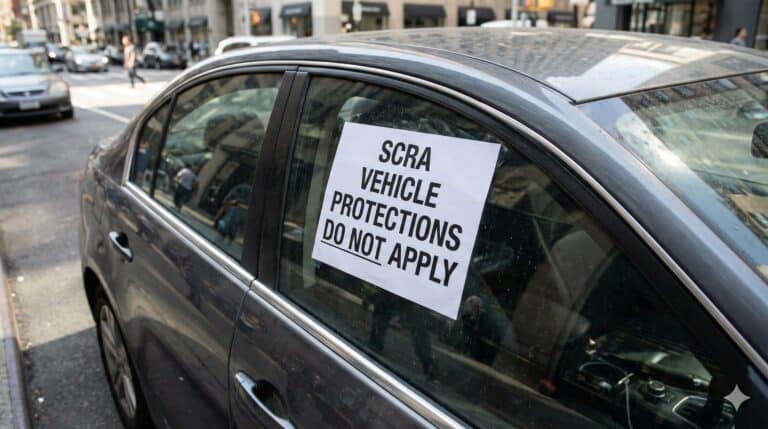
The Servicemembers Civil Relief Act prohibits any person or entity from enforcing a storage lien against the tangible personal property of an active duty military member without a court order. This protection covers motor vehicle registration privileges, vessel registration privileges, and all motor vehicle privileges, including cars, trucks, motorcycles, trailers, boats, RVs, and any other abandoned automobiles or vehicles. Title services may be processing abandoned cars. Such vessel types and every lost or abandoned article held in storage fall under this rule without exception.
The requirement applies during the period of military service and for 90 days after it ends. Good faith effort is the legal standard. In practice, that means running a verified check against the Defense Manpower Data Center database before the sale date. A written notice of sale means nothing if the registered owner is a servicemember; the law protects. Failure to verify triggers potential federal criminal liability: a fine, imprisonment of up to one year, or both.
A military verification service that provides court-ready affidavits is the documented proof the Department of Justice expects to find in your file. The DOJ has sued multiple Florida towing operators for selling vehicles without this step. In each case, the operators had followed every state procedure correctly. The federal step was the one they missed, and it cost them.
How Military Verification Works in Practice for Florida Operators
The Defense Manpower Data Center offers a free public search tool. Most operators attempt to start there. The problem is that the DMDC requires a Social Security number or date of birth to return a reliable result, and the language it produces is often ambiguous enough that courts have rejected it as proof of compliance.
SCRACVS accesses the same Department of Defense database but returns a clear yes or no on active duty status without requiring a Social Security number. That matters for towing storage operators who may hold only the registered owner’s name and a vehicle identification number from the title record. The result arrives the same or next business day as a court-ready affidavit, which belongs in the vehicle file as documented proof of reasonable effort and reasonable attempt to comply with federal law.
For high-volume operators, batch processing handles 50 to 10,000 or more records per month. Pay-per-use pricing means no subscription commitment and no overhead during slower months. The standard the DOJ expects is straightforward: run the check, document the result, and retain the affidavit in the file. A military status verification for towing operators makes that standard reachable for any operation size.
The Public Sale and Final Disposition of an Abandoned Vehicle in Florida
Once SCRA verification confirms the registered owner is not on active duty, or you have obtained a court order for a protected servicemember, the public sale can proceed pursuant to Florida Statute 713.78.
Under HB 179, effective July 1, 2024, abandoned automobiles more than three model years old may be sold 35 days after the date of storage. Vehicles three model years or newer require a 57-day wait. The public sale pursuant to statute requires open bidding and advertised notice. A local newspaper must carry the vehicle’s make, model, VIN, and license plate as the published notice in practice.
If the registered owner, or any person acting under a power of attorney or authorized representative, contests the agency’s intended disposition, such a hearing before an administrative law judge or local judge may follow. Such an election to request a hearing must occur within a defined window after the agency serves such notice of the intended disposition. Any person authorized to represent the registered owner may participate in such a hearing.
After the sale, surplus funds stay in a governmental entity’s care in an interest-bearing account. Unclaimed amounts, including lost property that was never retrieved and surplus proceeds the rightful owner never claimed, may flow to the state school fund under Chapter 705.
Vessels follow a parallel process under vessel registration privileges and the applicable sections governing abandoned or lost property. If the vehicle qualifies as a public nuisance pursuant to local ordinance, additional disposal options through a charitable organization or state agency may apply.
The Florida Abandoned Vehicle Title Process Has One Step That Can’t Be Delegated to Chance
The steps in Florida’s abandoned vehicle title process are procedural and manageable. The legal risk concentrates in one place: SCRA compliance before the sale date.
Florida operators have paid tens of thousands in federal penalties not because they ignored the law, but because they did not know this specific step existed. Military verification is not paperwork overhead. It is the documented proof that separates compliant operators from those facing a Department of Justice investigation.
For towing operators and storage facilities processing multiple vehicles monthly, SCRACVS military verification delivers same-day results, court-ready affidavits, and batch processing without requiring a Social Security number. That is the standard the DOJ expects to find in your file.
FAQs
What law governs the Florida abandoned vehicle title process?
In Florida, the title transfer process for an abandoned vehicle is governed by Florida Statutes §705.101 through §705.106 and Chapter 715, which outlines the procedures for handling lost or abandoned property. Obtaining a title requires a multi-step legal process: confirming the vehicle qualifies as abandoned, performing a VIN search, sending statutory notices, waiting the required period, and applying for a title through FLHSMV or the local County Tax Collector’s office.
What must a law enforcement officer do when they find an abandoned vehicle on public property?
Whenever a law enforcement officer ascertains that an article of lost or abandoned property is present on public property and is of such nature that officers can easily remove it, the officer must take such article into custody and make a reasonable attempt to ascertain the rightful owner or lienholder.
If the law enforcement officer determines the vehicle cannot be easily removed, the officer must place notice on the vehicle stating that the owner must remove it within five days or the agency will dispose of it according to Chapter 705, Florida Statutes.
If the owner or any person interested in the abandoned property does not remove it within the specified time after such notice, the law enforcement agency may retain the property for its own use, sell it, or dispose of it through other authorized means.
What forms are required to apply for an abandoned vehicle title in Florida?
To apply for a title, you must submit Form HSMV 82040, proof of notification, and any required fees to the local County Tax Collector’s office. Verification of the VIN and odometer is necessary and is completed using Form HSMV 82042 by law enforcement or a notary. If the vehicle remains unclaimed after the notice period, you can apply for a title through a public sale or a bonded title process. The bonded title route also requires Form HSMV 82033 and a surety bond equal to the vehicle’s appraised value.
What are the public auction requirements for an abandoned vehicle in Florida?
A public auction requires advertising the vehicle for sale in a local newspaper, including details such as make, model, VIN, and license plate number. The auction must run as open competitive bidding, and proceeds apply first to towing, storage fees, and notice costs. Any surplus after those costs goes into an interest-bearing account for the rightful owner. According to Florida Statutes, if the owner of an abandoned vehicle does not respond within a specified time after notice, the law enforcement agency or towing storage operator may sell it, and the owner bears liability for all associated costs.
Can a towing company sell an abandoned car in Florida without a court order?
Under Florida Statute 713.78, a towing storage operator can sell an unclaimed vehicle to satisfy a storage lien after proper notice and the required waiting period. The federal exception changes that entirely: if the registered owner is on active military duty, the Servicemembers Civil Relief Act requires a court order before anyone can enforce the lien. This federal requirement overrides Florida state procedure. The Department of Justice has sued multiple Florida towing companies for selling vehicles owned by active duty servicemembers without a court order, resulting in penalties that reached six figures in several cases.