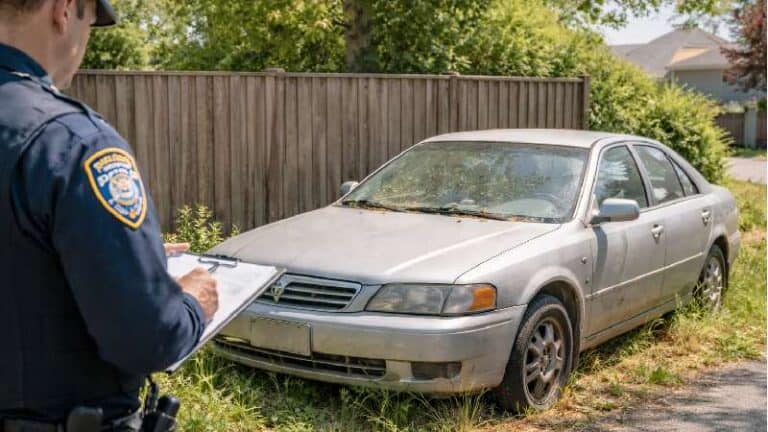

Michigan Abandoned Vehicle Title Process: A Step-by-Step Guide
You pulled an abandoned car from a parking lot three weeks ago. You followed every notice requirement. The 20-day window closed. Now you’re ready to auction the vehicle and recover your storage fees. There’s one check most towing agencies skip at this exact moment, and the Department of Justice has taken companies to court for skipping it. That check takes minutes. The lawsuit does not.
What Qualifies as an Abandoned Vehicle in Michigan
Not every car parked in the wrong spot qualifies as abandoned under Michigan law. Before a towing agency initiates any removal, the vehicle must meet specific statutory conditions.
Under Michigan Vehicle Code MCL 257.252a, a vehicle on public property qualifies as abandoned after sitting for 48 hours. On state trunk line highways, that window shortens to 18 hours when the vehicle displays a valid registration plate.
A vehicle on private property qualifies as abandoned when it remains there without the property owner’s consent. Michigan also classifies a vehicle as abandoned when a crash preceded a law enforcement release and the owner failed to redeem it within 20 days of that release date.
Michigan law covers a wfxider range of assets than most people assume. Vehicle includes motor vehicles, off road vehicles, and snowmobiles. Vessel includes watercraft. A boat parked on private property without consent, a motorcycle left on public property past the 48 hour mark, or a vessel removed from a marina slip it does not belong in all move through the same statutory process as a standard abandoned car.
Two situations fall outside the abandonment definition entirely. When a vehicle is reported stolen, law enforcement must determine whether it appears in LEIN as stolen before any removal takes place. A stolen vehicle follows a separate legal process. Unpaid parking tickets may affect what the owner ultimately owes, but they do not change the abandonment timeline or trigger the Michigan abandoned vehicle title process on their own.
The Roles in Michigan’s Abandoned Vehicle Process
Three parties drive the Michigan abandoned vehicle title process: law enforcement, custodians, and the Secretary of State. Each carries defined responsibilities, and coordination gaps between them produce the documentation failures that create problems during disputes.
Law enforcement initiates custody. When a vehicle appears abandoned on public property, the police agency makes the decision to remove it. On private property, the property owner or a business or legal entity responsible for that location contacts local authorities or a towing agency to report the vehicle. Before any removal from private property, the towing agency must notify a police agency by telephone or otherwise that the vehicle is being removed. That notification requirement is mandatory and documented.
The custodian is the legal entity responsible for towing and storage once the vehicle leaves its location. Michigan requires towing companies operating as custodians to register with the Secretary of State before processing any abandoned vehicles. That registration grants access to the state’s online Abandoned Vehicle Search system, which both law enforcement and registered custodians use to track vehicles in custody. A towing agency that processes abandoned vehicles without completing that registration accumulates compliance exposure before the vehicle even arrives at the storage facility.
The Secretary of State manages notification, title issuance, and the mandatory fund remittance. The department receives LEIN entries, sends notices to last titled owners and secured parties, issues titles or certificates of scrapping, and deposits the $25 per vehicle remittance that custodians must submit into the Abandoned Vehicle Fund. Private property owners cannot claim ownership of a vehicle abandoned on their land. They must engage a registered towing agency and initiate the state process through proper channels.
Step by Step: The Michigan Abandoned Vehicle Title Process
The process runs in a defined legal sequence. Custodians who understand each step and each deadline avoid the compliance failures that generate disputes and delay disposition.
Step 1: Vehicle Taken into Custody
The towing agency takes the vehicle into custody from its location, whether on public property or private property. Before removing any vehicle from private property, the agency must contact a police agency. Custodians should document the date, time, and method of that notification. If the vehicle owner later files a dispute, the absence of that contact record undermines the entire process.
Step 2: LEIN Entry Within 24 Hours
Within 24 hours of the vehicle entering custody, the police agency enters it into LEIN as abandoned. For vehicles removed from private property, that entry triggers a notification to the Secretary of State that the vehicle is now in custody. Custodians should confirm the LEIN entry with the police agency and retain confirmation of the entry date. Every downstream deadline runs from this point.
Step 3: Secretary of State Mails the Notice
Within 7 days of the vehicle entering custody, the Secretary of State mails the Notice of Abandoned Vehicle/Vessel, Form TR-52E, to the last titled owner and any secured party on record. The notice includes the vehicle year, make, and VIN; the address where the vehicle was taken from; the date it entered custody; and the contact information for the police agency involved.
The notice also warns the owner that failure to redeem or request a hearing within 20 calendar days of the notice date will result in termination of all ownership rights and rights of any secured party.
Step 4: The Owner’s 20-Day Window
The registered owner has 20 calendar days from the date on the notice to act. That person can redeem the vehicle by paying towing and storage fees directly to the custodian. Or that person can file a petition with the court to contest either the abandonment determination or the reasonableness of the fees charged.
Filing requires posting a bond of $40 plus all accrued storage fees with the court before a hearing date can be set. Vehicle owners who pay the bond and file the petition within the window preserve their rights. Those who do not contact the custodian, file a petition, or pay the required fees within 20 days forfeit all claim to the vehicle.
Step 5: Disposition
Once the 20-day redemption period closes without a claim, the custodian proceeds with disposition. Two paths exist depending on the vehicle’s condition.
For scrap vehicles, the police agency completes a release form and hands it to the custodian. The custodian then applies for a Certificate of Scrapping from the Secretary of State. After the department issues that certificate, the Secretary of State will not issue another standard title for that vehicle. The vehicle exits the ownership chain permanently.
For vehicles that are not scrap, the custodian must offer them for sale at a public auction. Buyers at that auction receive an Abandoned Vehicle Bill of Sale, Form TR-52L, which they use to apply for a new title through the Secretary of State. The custodian remits $25 from the auction fee to the Secretary of State within 30 days of receipt, deposited into the Abandoned Vehicle Fund.
Towing and Storage Fees: What Custodians Can Charge
Michigan law permits custodians to charge towing and storage fees, but registered owners retain the right to dispute those fees through the court petition process. That dispute right creates real exposure for custodians who cannot produce clean, timestamped fee documentation.
Storage fees accrue from the date the vehicle enters custody. Custodians set their own daily rates, subject to the reasonableness standard courts apply during hearings. When an owner files a petition to contest costs, the court reviews the fee structure in detail. Custodians whose rates appear excessive relative to prevailing market rates tend to lose those hearings, which reduces recovery and extends the overall disposition timeline.
The $40 bond plus accrued fees that an owner must post before the court schedules a hearing gives custodians meaningful protection against bad faith disputes. That bond goes into court custody, not to the disputing owner, until the hearing concludes. The protection only works when custodians can produce records showing the exact date fees began, the daily rate applied, and the total accrued on any given date.
Custodians who build a simple fee log into their intake process, noting the custody date, daily storage rate, and running total, find that disputes resolve quickly in their favor. Those who reconstruct fees from memory after a dispute is filed tend to struggle.
Bonded Title: When Standard Proof of Ownership Does Not Exist
Some abandoned vehicles arrive with incomplete or missing paperwork. The previous owner cannot be located. The title history shows gaps. In these situations, a bonded title may be the only path to establishing clean vehicle ownership.
Michigan statute 257.217 requires a surety bond equal to twice the vehicle’s fair market value for applicants who cannot produce adequate proof of ownership. The bond remains active for three years from the date of issuance. During that window, the rightful owner can file a claim against the bond if they appear and demonstrate valid ownership of the vehicle.
Custodians and buyers at abandoned vehicle auctions encounter the bonded title route more often than they expect. A vehicle with liens still attached, or one where the registration does not match the title history, often requires this approach. The Secretary of State needs assurance that the legitimate owner will receive compensation if the title applicant later turns out to have had no valid claim.
For vehicles where documentation is lost entirely or the previous owner is simply unable to be identified after all reasonable attempts to contact them, visiting a Secretary of State branch office and requesting guidance on the bonded title application is the right starting point.
The SCRA Verification Step Most Towing Agencies Skip
When the registered owner of that abandoned car turns out to be an active duty military servicemember, state procedural compliance does not protect the custodian from federal liability. This is where the Michigan process and federal law intersect in a way the state’s abandoned vehicle statute does not address.
Under the Servicemembers Civil Relief Act (50 U.S.C. § 3952), any entity with a security interest in a vehicle cannot force the sale of that vehicle without a court order if the owner is on active military duty and the underlying contract predates their service. Michigan’s 20-day notice window is a state statutory deadline. It does not override the rights of a deployed servicemember who was not reachable during that period.
The Department of Justice has pursued towing companies directly for this violation. S&K Towing auctioned nearly 150 vehicles, including those owned by deployed servicemembers, without obtaining court orders as federal law requires. The DOJ action that followed was a federal lawsuit, not a local regulatory citation. Companies subject to SCRA enforcement face consequences that dwarf anything they recovered at auction.
The Defense Manpower Data Center maintains a free military status lookup at scra.dmdc.osd.mil. The limitation of the free tool is the documentation. It returns a basic result with no audit trail that holds up during a compliance review or federal inquiry. For towing agencies and custodians processing multiple vehicles, a military verification service for towing agency provides the documented verification results and audit trail that protect the business if questions arise later.
Verifying military status before proceeding with any auction or scrap takes minutes. Running that check before disposition costs nothing close to what SCRA litigation costs. Every vehicle in custody should go through this verification before the 20-day window closes and before any selling begins.
What Goes Wrong and How to Protect Yourself
The Michigan abandoned vehicle title process has enough moving parts that errors tend to cluster around the same pressure points. Custodians who know where those points are can put documentation systems in place before they need them.
Failing to notify law enforcement before removing a vehicle from private property is the most common early-stage error. It appears procedural. Courts treat it as a compliance failure that can void the entire abandonment process.
Missing the Secretary of State’s 7-day notification window happens when LEIN entry gets delayed, or custody documentation falls behind. Custodians who cannot confirm the LEIN entry date cannot confirm the notice went out on time, which gives determined owners grounds to dispute the abandonment determination.
Proceeding with the auction before the 20-day owner window closes generates the clearest legal exposure short of SCRA violations. The 20 days run from the date on the notice, not from the date of custody. Custodians who calculate from the wrong date and sell early open themselves to claims that the vehicle owner never received a fair opportunity to redeem their property.
Disposing of a vehicle without verifying military status sits at the top of the federal risk register. State law does not require this step. Federal law does. The DOJ does not defer to state procedural compliance when an SCRA violation is on the table.
Document every action: date of custody, LEIN entry confirmation, TR-52E mailing records, military verification results, auction documentation, and fee receipts. That paper trail does not prevent problems from arising. It determines whether you can defend your business when one does.
Before You Auction That Vehicle, Run This Check
Michigan’s abandoned vehicle title process is detailed, but it rewards custodians who treat it as a system rather than a checklist. The timelines are tight. The documentation requirements are specific. The Secretary of State’s role is active and deadline-driven. Towing agencies that build these procedures into standard operations move through each case cleanly, without accumulating the compliance debt that tends to surface at the worst possible moment.
The military verification step sits outside the Michigan statutory process entirely, which is exactly why most towing agencies miss it. State law does not prompt you to do it. Federal law requires it. The risk of getting it wrong is not a local fine. The SCRA is a federal civil rights statute, and enforcement actions under it carry consequences that are difficult to reverse once a custodian has sold the vehicle.
SCRACVS provides SCRA verification services for towing companies, impound operators, and any business or legal entity processing abandoned vehicles. The service queries DMDC databases and returns documented verification results with a full audit trail. Before any vehicle in custody moves to auction or scrap under the Michigan abandoned vehicle title process, run the verification. One check removes the single largest federal compliance risk in a process you already know how to run.
FAQs
In Michigan, what should a private property owner do if they find an abandoned vehicle on their property?
Private property owners in Michigan must contact a local towing company or law enforcement to report the abandoned vehicle. A registered towing agency cannot remove the vehicle from private property without first notifying a police agency having jurisdiction over that location. Removal does not happen at the property owner’s discretion alone. Michigan law drives the sequence, and private owners who attempt to remove or dispose of the vehicle independently create legal exposure for themselves.
Do apartment complexes and private property owners need to post signage before a towing company can remove a vehicle?
Yes. Michigan requires private real property owners and apartment complexes to post a warning sign stating that unauthorized vehicles will be removed at the owner’s expense before a towing agency can remove any vehicle from that location. The sign must include the towing agency’s contact information. Towing a vehicle without proper signage in place gives the vehicle owner grounds to dispute the removal and potentially recover their costs from the towing agency.
Who is responsible for determining whether a vehicle is stolen before removal?
Law enforcement carries that responsibility. When a vehicle is reported abandoned, police must verify whether it appears in LEIN as stolen before any removal takes place. A vehicle that appears stolen follows a different legal process. Custodians should confirm with the police agency that officers ran a LEIN check and that the vehicle did not appear as stolen before accepting custody.
How does a person claim ownership of an abandoned vehicle in Michigan?
To claim ownership of an abandoned vehicle in Michigan, the interested party must file a petition with the court within 20 calendar days from the date printed on the Notice of Abandoned Vehicle, Form TR-52E. Filing after that date forfeits all rights to the vehicle and to any proceeds from its sale at auction.
What does the process to obtain a title for an abandoned vehicle require?
Obtaining a title through the abandoned vehicle process typically requires submitting specific forms to the Secretary of State, paying a filing fee of $75, and providing proof of towing and storage fees paid to the custodian. The Secretary of State requires this documentation to confirm that the claimant followed proper notice procedures and made good faith attempts to contact the owner before pursuing title.
What documentation is required when claiming an abandoned vehicle?
The claimant must provide evidence of the vehicle’s abandonment and documentation of all attempts to contact the registered owner. That includes proof of notice sent, records of address verification efforts, and receipts for all associated fees paid. Courts and the Secretary of State require this evidence to confirm the claimant followed the abandonment process lawfully before any title transfer proceeds.
Most jurisdictions require reporting the vehicle to local authorities to verify its abandonment status before any claim of ownership proceeds. Law enforcement confirms the LEIN entry and establishes the official date the vehicle entered custody, which anchors the entire notification timeline that follows.
What happens to a vehicle classified as an abandoned scrap vehicle?
A vehicle classified as an abandoned scrap vehicle receives a Certificate of Scrapping from the Secretary of State rather than a standard title. After the department issues that certificate, no title for that vehicle can be issued again. The vehicle exits the ownership chain permanently and goes to a used vehicle parts dealer or a vehicle scrap metal processor.
How long does the Michigan abandoned vehicle title process typically take?
The typical waiting period runs approximately 25 to 27 days from the date the Secretary of State sends the notice. That accounts for the 7 days the department takes to mail the notice after LEIN entry, plus the 20-day owner redemption window. Custodians should add additional time for LEIN entry confirmation at the front end and Secretary of State processing of disposition paperwork at the back end.
What does it mean for a vehicle to be considered abandoned?
A vehicle is considered abandoned when it remains on public or private property without the owner’s authorization for a period defined by law. In Michigan, that period is 48 hours on public property and 18 hours on state trunk line highways for vehicles with valid plates. Signs of neglect, including flat tires, broken windows, or a lack of current registration, may indicate abandonment, but those signs alone do not trigger the legal process. The statutory time period and location determine whether the vehicle qualifies under MCL 257.252a.
Can someone take possession of an abandoned vehicle left on their property without going through the legal process?
No. Individuals cannot claim an abandoned vehicle found on their property simply by taking possession of it. Michigan law requires following the full statutory process, including towing agency notification, law enforcement contact, Secretary of State notice, and either a public auction or a formal title application. Bypassing that process leaves the person subject to claims from the original owner and prevents them from obtaining a clean title.
What happens if no one claims the vehicle within the notification period?
If the vehicle is not claimed within the 20-day redemption period, the custodian must offer it for sale at a public auction. The vehicle cannot be kept privately, scrapped without a certificate, or sold through informal channels. The auction requirement ensures that the process remains transparent and that proceeds flow through the proper channels, including the $25 remittance to the Secretary of State’s Abandoned Vehicle Fund.