Military Service Number: What It Is & Why It Matters For SCRA Verification
Many landlords, lenders, and legal professionals come across military documents showing a service number and assume that SCRA protections automatically apply. Acting on that assumption without verification can create compliance risks and costly delays.
From 1918 to 1974, military service numbers were the main identifiers for military personnel before the Department of Defense replaced them with Social Security Numbers, as noted by the National Archives’ historical record. These numbers once appeared across all branches of service, from the Army and Navy to the Air Force and Marine Corps.
Although older military service records and veteran documents still display these numbers, they no longer confirm active duty or SCRA eligibility.
This guide explains what a military service number is, how it was used, and when it remains relevant for legal verification under the Servicemembers Civil Relief Act.
Key Takeaways
- A military service number is a unique identifier that the armed forces use to track a service member’s records, pay, assignments, and benefits.
- In the United States, service numbers were the main identifier from about 1918 until they were replaced by Social Security Numbers as the primary personal identifier in the 1970s.
- Older service numbers help locate historical service records, but they do not confirm that someone is currently on active duty or covered by SCRA.
- Modern United States military systems rely on a Department of Defense identification number and central status databases instead of the old service number.
- For SCRA compliance, landlords, lenders, and law firms should always use an official military status verification service, not just rely on a claimed service number or military story.
What Is A Military Service Number?
A military service number is a unique personnel identifier once assigned to every member of the armed forces. Each service member received a distinct number that followed them throughout their military service, allowing the government to maintain organized and accurate records. It served as an internal control system that helped military departments track individuals through enlistment, promotions, and separation.
Unlike equipment serial numbers or national identity documents, a service number identifies people, not property. Administrative and personnel offices used it to manage the careers of each enlisted person and officer across various branches, including the Army, Navy, Air Force, Marine Corps, and Coast Guard.
The service number tied together a range of critical records, such as:
- Personnel files containing enlistment and discharge information
- Medical records documenting treatment, evaluations, and procedures
- Performance and disciplinary reports that detailed conduct and achievements
- Awards, commendations, and decorations earned during service
- Discharge papers and benefit eligibility records are used after separation
When a veteran contacted a funeral home for honors or requested benefits through the National Personnel Records Center, this number made it possible to locate the correct military service records among millions of archived files. It confirmed the identity of the person who served and connected every document from their time in the armed forces.
This numbering system offered structure and consistency across all branches of service. Although it has been replaced in modern operations, the military service number continues to hold value for accessing historical files and verifying a veteran’s past military service.
Why Was It Important?
When millions of Americans joined the armed forces during major conflicts, the military needed a way to keep every soldier, sailor, airman, and marine accounted for. Names alone weren’t enough. The military service number became the anchor that tied each person’s identity to their records, pay, and performance. It made mobilization possible at a scale the country had never faced before.
That same number still follows many veterans long after their service ended. You can find it on discharge papers, court exhibits, and veteran benefit forms because it remains part of how older files were indexed. When attorneys, funeral homes, or government offices request proof of service, the service number often becomes the fastest way to locate the right file in decades-old archives.
For anyone who served before the 1970s, the number can still unlock access to the National Personnel Records Center or other repositories that hold personnel files and medical records.
While modern systems now rely on a Department of Defense ID number, these older identifiers continue to bridge the past and present of military verification, connecting today’s legal processes to the service history that shaped them.
Historical Overview: Service Numbers In The United States
When were service numbers introduced?
The use of service numbers began in 1918 when the Department of War needed a reliable way to manage the surge of new recruits during the First World War. As enlistments soared, handwritten rosters could no longer keep pace with the size of the Army.
To solve this, each soldier was assigned a personal number that stayed with them through their entire military service. The system created order where chaos once existed, linking every record to a single person regardless of where they were stationed or how long they served.
Soon, other branches adopted the same approach. The Navy, Marine Corps, Air Force, and Coast Guard followed, each developing its own numbering structure but sharing the same goal: consistent documentation across the armed forces. This simple idea revolutionized record-keeping and laid the foundation for modern military personnel systems.
How Long Have They Been Used?
From 1918 through the 1970s, the United States military relied on service numbers as the primary way to identify every person in uniform. Whether a soldier was serving in the Army, flying with the Air Force, or stationed at sea with the Navy, their service number connected every part of their official record.
The system began to change in the early nineteen seventies when the Department of Defense replaced service numbers with Social Security Numbers. This transition aligned military record-keeping with civilian systems and supported new federal privacy standards, including the Privacy Act of 1974.
Using one identifier for both military and government databases made administrative work faster and more efficient.
Although no longer active, those earlier numbers never disappeared. They remain printed on archived military records, personnel files, and veteran documents preserved at the National Personnel Records Center and other federal archives. For historians, veterans, and legal professionals, they continue to serve as valuable reference points for tracing a person’s military service.
Service Number Formats and Ranges in the United States
1. Branch-specific examples
Each branch of the armed forces developed its own structure for assigning service numbers. While the purpose was the same across all divisions, organizing personnel and tracking records, the formats varied to suit different administrative systems.
- Army and Air Force: Enlisted personnel were grouped into number ranges that occasionally reflected where they enlisted or whether they were drafted. As wars expanded and troop counts grew, new number ranges were opened to handle large waves of mobilization. These identifiers often stayed consistent throughout a service member’s career.
- Navy: The Navy followed a completely different sequence. Its enlisted numbers were grouped by internal categories rather than geography. Sailors from different fleets or commands could have similar ranges, but their records were managed independently within the Navy’s personnel offices.
- Marine Corps: Early Marine Corps service numbers were shorter, commonly around six digits. As the branch grew during wartime, new series were added, but the numbering stayed simpler compared to the larger forces.
- Officers: Officer numbers were typically much shorter, often just a few digits in older eras. Because officers were fewer in number, their identifiers were easier to manage and often recorded manually in central files.
These differences highlight how each branch built its own administrative rhythm during decades of expansion.
While such patterns offer clues about when and where someone served, they cannot confirm service on their own. Only verified military records or official SCRA verification can provide proof of duty status.
Ranges and Reserved Blocks
The official service number system in the United States could, in theory, assign numbers from 1 to 99,999,999. In practice, only a fraction of those numbers were ever issued. Each branch managed its own allocation, using different blocks for enlisted personnel, officers, and special programs.
Some portions of the number range were reserved for specific groups within the armed forces. For example:
- Certain blocks were designated for National Guard members to distinguish them from regular Army personnel.
- Separate series were later created for institutions such as the Air Force Academy and other training commands.
- Additional sequences were occasionally set aside for administrative or testing purposes that never reached active use.
These patterns offer valuable context for researchers and archivists studying military service records, but they hold no verification value for legal or business purposes.
A service number alone cannot prove that someone currently serves or qualifies for protections under the Servicemembers Civil Relief Act. For landlords, lenders, or attorneys, only an official military verification process confirms a person’s active duty status.
Simplified United States Service Number Overview
Each branch of the armed forces managed its own numbering system, often reflecting differences in size, structure, and administrative methods.
The following table provides a simplified overview to help illustrate how service numbers varied across branches and time periods. It is meant to show general patterns, not to serve as a verification guide, since official confirmation of service must always come from an authorized military verification process.
| Branch | Typical Era of Use | Common Format Style | Notes |
|---|---|---|---|
| Army and Air Force enlisted | 1918 to the early 1970s | Usually eight digits, sometimes grouped to reflect region or draft category | Expanded rapidly during large mobilizations such as World War II and the Korean War |
| Navy enlisted | 1920s to early 1970s | Grouped patterns unique to naval personnel systems | Managed separately by fleet and command offices |
| Marine Corps enlisted | 1920s to early 1970s | Often, six-digit identifiers in earlier years were later expanded | Simpler sequences due to smaller personnel size |
| Officers across branches | 1918 to the early 1970s | Commonly short numbers, sometimes only a few digits | Centralized management because of smaller officer populations |
While these numbering styles may appear consistent, it is important to remember that scammers can easily replicate plausible formats. Only verified military records and authorized SCRA verification services can confirm if a person truly served.
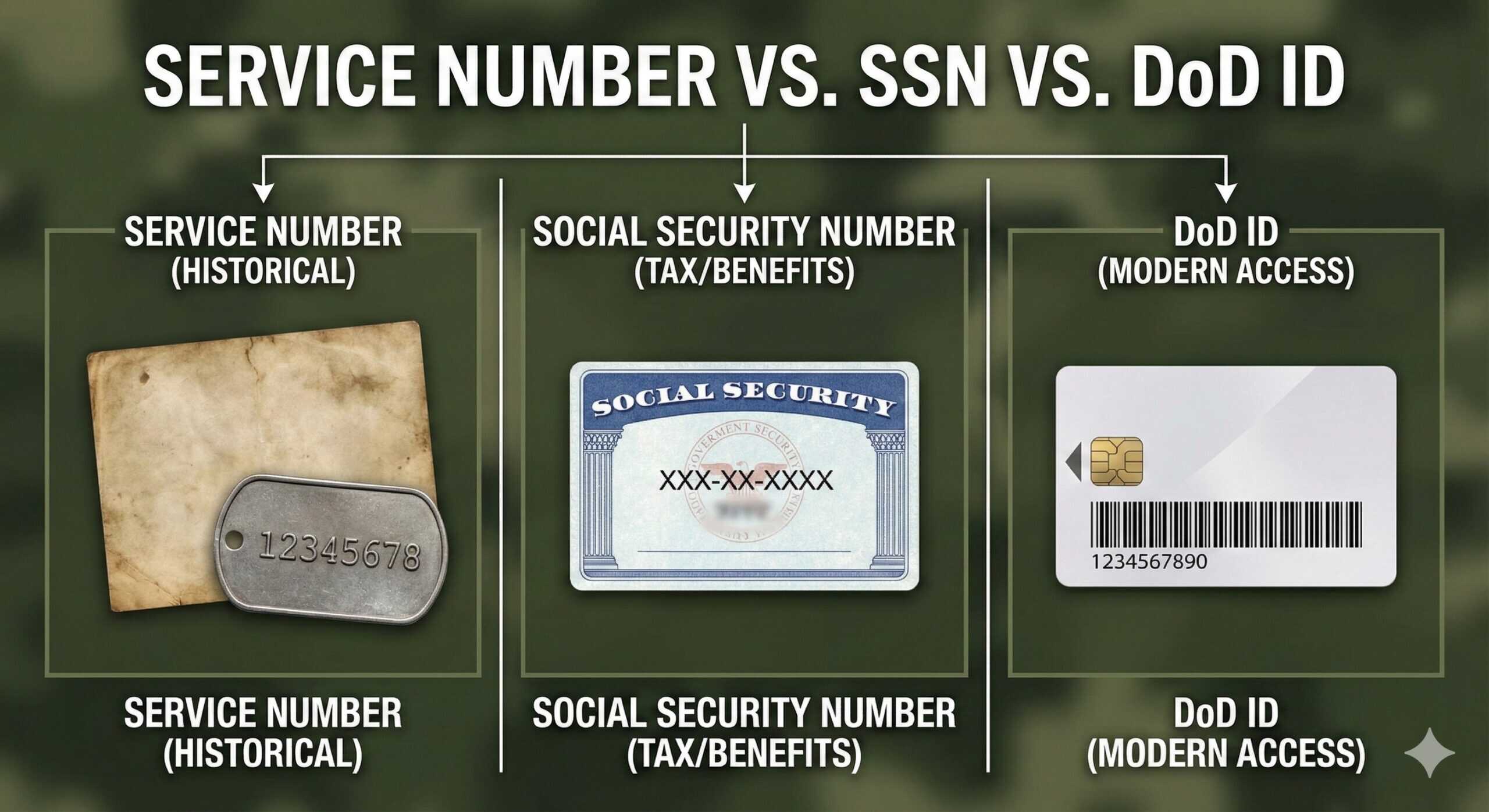
Service Number Versus Social Security Number Versus DoD ID
Each of these identifiers serves a distinct purpose and reflects a different stage in how the United States military manages personnel records. Understanding these differences helps prevent mistakes when reviewing documents or confirming someone’s military status.
The service number was the original identifier used by the armed forces from the early twentieth century until the nineteen seventies. It appeared on enlistment forms, medical files, and discharge papers, linking every piece of a service member’s record.
Today, it mainly appears on veteran documents and archived personnel files at the National Personnel Records Center, where it remains helpful for retrieving older records or processing benefit requests.
The Social Security Number replaced the service number in the nineteen seventies as the primary personal identifier within the military. This shift aligned defense record systems with civilian databases and simplified administrative work.
Because the Social Security Number is tied to tax, credit, and personal data, it became highly regulated under the Privacy Act of nineteen seventy four and is now treated as sensitive information across all federal systems.
The Department of Defense identification number, or DoD ID, represents the current stage of record management. It appears on Common Access Cards issued to all active duty members, reservists, and civilian employees of the Department of Defense.
This number is used within secure defense networks for access control and military verification processes, offering a safer, more efficient alternative to using personal Social Security Numbers in military operations.
Comparison of Military Identifiers
The following table summarizes the differences in purpose and relevance among the three main identifiers. While each appears on various military or legal documents, none of them alone can confirm current military service.
For SCRA compliance, verification must always include confirmation of active duty status for specific dates rather than relying on a claimed number.
| Identifier Type | Main Period of Use | Primary Purpose | Where a Landlord or Law Firm Might See It | Can It Prove Active Duty Today |
|---|---|---|---|---|
| Service Number | 1918 to the 1970s | Historical military personnel identifier used to track records, pay, and benefits | Older discharge papers, veteran documents, archived personnel or medical records | No. Useful only for historical or benefit lookups |
| Social Security Number | 1970s to present | Civilian national identifier used for taxes and military record alignment | Employment forms, credit checks, or past military paperwork | No. Highly sensitive and not valid proof of active service |
| DoD Identification Number | 2010s to present | Modern internal military identifier used within defense systems | Common Access Cards or official correspondence from active duty personnel | No. Must still be verified through official SCRA or DoD databases |
Why Military Service Numbers Matter for Landlords, Law Firms, Lenders, and Tow Companies
Military-related documents can surface in various situations, often when an individual faces financial or legal action.
A tenant may claim to be serving in the military or a veteran and attach paperwork that includes a service number. A borrower who has fallen behind on payments might send a scan of an old discharge paper that only shows that number. A vehicle owner whose car has been repossessed or towed may insist that no action can be taken because they are protected under the Servicemembers Civil Relief Act (SCRA) and point to a service-related record as proof.
These documents can appear convincing, especially when they come from older military files. Yet for anyone handling a lease, loan, or repossession, it is essential to know what a service number can and cannot reveal.
What the Number Can and Cannot Tell You
A service number can indicate that the person was once connected to the armed forces, particularly if the paperwork appears consistent with older Army, Navy, or Air Force formats. It may help locate records in archives or confirm that the person served during a historical period, but its value ends there.
What it cannot confirm includes:
- Whether the person is currently on active duty
- Whether they were serving on a specific date relevant to an eviction, repossession, or court proceeding
- Whether SCRA protections apply to the situation in question
For example, a landlord once delayed eviction proceedings after a tenant presented a letter with a service number and claimed military protection. Weeks later, verification showed that the tenant had retired years earlier and was no longer covered by the SCRA. The delay caused significant financial and legal complications that could have been avoided through proper verification.
A service number alone does not establish active military status. It is only an indicator of past service, not current protection. To stay compliant and avoid costly errors, landlords, lenders, and attorneys must rely on official military verification systems rather than assumptions based on old documents.
How Service Numbers Are Used in Records Research and Historical Verification
Role in Records Requests
For military service that began before the 1970s, a service number remains one of the key details used to locate official files.
When submitting a records request to the National Personnel Records Center or the National Archives, including this number helps staff locate the right file among millions of entries. Many historical personnel, medical, and discharge records are indexed by service number, which makes it easier to separate individuals who share the same name or birth date.
The process is methodical and often takes time because these archives handle preservation and retrieval rather than real-time updates. It serves veterans, families, and researchers who need historical documentation, not those seeking confirmation of current military service.
Use in Verification and Compliance Tools
Some verification tools reference service numbers as part of archival lookups or when confirming older military service records. These numbers can help validate historical details, but they are not considered sensitive identifiers like Social Security Numbers or DoD ID numbers.
For SCRA verification, what matters is not the presence of a service number but whether the person is on qualifying active duty for specific dates. That determination comes from modern Department of Defense databases and official verification systems, which are designed to provide accurate, date-specific confirmation rather than historical context.
What to Do When Someone Mentions a Military Service Number
1. Do Not Treat the Number as Final Proof
Seeing a military service number on a document may look convincing, but it should never be taken as confirmation that someone currently qualifies for SCRA protections.
Many landlords, lenders, and legal professionals make the mistake of assuming that the presence of a service number automatically means active duty status. In reality, these numbers often belong to veterans whose service ended decades ago.
Even when the paperwork is authentic, the number itself does not prove that the individual is now serving or was on active duty during the specific dates relevant to a lease, loan, or repossession. Acting on that assumption can delay proceedings or create compliance issues if SCRA protections do not actually apply.
The safest approach is to view a service number as a potential clue, not as verification. Always confirm military status through an approved SCRA verification service that checks real-time Department of Defense records before making any legal or financial decision.
2. Collect Information, Then Verify Status Properly
When someone claims military service or SCRA protection, begin by gathering as much accurate information as possible. Collecting complete details helps ensure that any verification request produces reliable results.
The key information includes:
- Full legal name
- Date of birth
- Any documents the person provides
- Claimed branch of service and approximate dates of service
Once these details are available, the next step is verification.
Always confirm the person’s military status through official channels such as the Defense Manpower Data Center (DMDC) or a specialized verification platform like SCRACVS. Services like SCRACVS provide court-ready documentation that can be used to confirm active duty status for legal and compliance purposes.
Using these verified sources ensures accuracy and protects landlords, lenders, and attorneys from the risks that come with acting on incomplete or outdated information.
3. Document Your Due Diligence
Courts and auditors often require documentation showing that you verified a person’s service before taking action on an eviction, repossession, or collection case.
Keep a clear record of:
- When the verification was performed
- The specific date range that was checked
- The result returned by the verification service
These details show that you acted responsibly and complied with the Servicemembers Civil Relief Act (SCRA). Storing verification reports, confirmation emails, or court-ready affidavits protects your business from disputes and helps demonstrate good-faith compliance if questions arise later.
Common Myths and Mistakes About Military Service Numbers
Myths That Cause Risk
Misunderstandings about military service numbers are among the most frequent causes of SCRA compliance issues. Many professionals still believe:
- Any document containing military language or symbols automatically activates SCRA protections.
- Seeing a number that resembles a service number means a person cannot face eviction or repossession.
- Verification is optional if the person appears honest or provides old military paperwork.
These assumptions can expose landlords, lenders, and law firms to significant legal risk. A document might look authentic, but still relate to a person who is no longer on active duty and therefore not protected under the SCRA.
How to Correct These Misunderstandings
The Servicemembers Civil Relief Act focuses entirely on current active duty status and the specific dates tied to a legal or financial action. Past service, a discharge record, or an old identifier cannot substitute for a formal verification.
To prevent mistakes:
- Establish internal policies that require military status checks whenever SCRA protections are claimed or suspected.
- Train staff to recognize that a service number is only the starting point for questions, not confirmation of protection.
- Keep clear documentation of every verification request and result for future reference.
When organizations follow a structured process and rely on verified data, they protect both their legal interests and the rights of genuine service members.
Turn Military Claims Into Verified Status
Military service numbers tell the story of a person’s past in uniform, but they do not answer the question that matters most today: is this person on active duty right now? For landlords, lenders, and legal professionals, that distinction defines whether the Servicemembers Civil Relief Act (SCRA) applies. Decisions about evictions, collections, or repossessions must rest on verified data, not assumptions drawn from historical documents.
Acting without accurate verification can lead to serious consequences, including delayed court cases, overturned judgments, financial penalties, and damage to credibility with regulators. Having documented proof of military status is not a technicality; it is a safeguard that protects both compliance and reputation.
That is where SCRACVS makes the process simple and reliable. The service connects directly to Department of Defense databases to deliver official, court-ready results. Whether you manage properties, handle repossessions, issue loans, or represent clients in court, SCRACVS provides the verified proof you need before taking action.
FAQs
Is a military service number the same as a Social Security Number?
No. A military service number was a unique identifier once used by the armed forces to manage personnel records, while a Social Security Number is a civilian identifier used for tax and administrative purposes. The Department of Defense replaced service numbers with Social Security Numbers in the nineteen seventies to streamline personnel records and comply with new federal privacy rules. Today, only archived military records and veteran documents still show service numbers.
Where can I find my or a family member’s military service number?
You can locate a service number on older discharge papers, personnel files, or medical records stored at the National Personnel Records Center or National Archives. Veterans or next of kin can request these military records using an official form and proof of relationship. If the service began after the nineteen seventies, the person likely does not have a service number because the Department of Defense identification number replaced it.
Can a military service number prove that someone is on active duty now?
No. A service number only reflects past military service and cannot confirm active duty status today. Even if the number appears on official-looking documents, it may belong to a veteran who no longer serves in the Army, Navy, Air Force, Marine Corps, or Coast Guard. To verify current military personnel status, use an approved SCRA verification tool that accesses the Defense Manpower Data Center.
What is the difference between a service number and a Department of Defense identification number?
A service number identified members of the armed forces before the nineteen seventies, while the Department of Defense identification number (DoD ID) is the modern internal identifier. The DoD ID number appears on Common Access Cards for active duty members, reservists, and civilian employees. Unlike service numbers, it connects directly to secure databases used for military verification, security access, and SCRA compliance.
Can landlords use a service number alone to decide if SCRA applies?
No. A service number cannot prove active duty or determine whether SCRA protections apply. Landlords must verify a tenant’s military status through the Defense Manpower Data Center or an authorized service like SCRACVS, which provides court-ready verification documents. Relying on an old Army or veteran record can result in delayed cases or penalties for noncompliance.
How should a law firm handle a tenant who provides an old service number on discharge papers?
A law firm should treat the discharge papers as potential evidence of past military service, not current SCRA eligibility. The next step is to verify the tenant’s military status using an official database or a trusted verification service. Firms can use SCRACVS to confirm whether the person is currently on active duty. This ensures accurate compliance documentation and protects against legal disputes.