Defense Manpower Data Center (DMDC)
What is the Defense Manpower Data Center?
DMDC Purpose & Function
The Defense Manpower Data Center is an important resource that the Servicemembers Civil Relief Act Centralized Verification Service uses to get the crucial military status information our clients need.
The Department of Defense maintains the Defense Manpower Data Center. The DMDC keeps records on individuals’ military statuses with start and termination dates of service.
Government Agencies
Seven government agencies provide personnel reports to the DMDC:
1. Army
2. Navy
3. National Guard
4. Marines
5. Air Force
6. Public Health Service
7. National Oceanic and Atmospheric Administration (NOAA)
8. Space Force
Each agency files a record with the Defense Enrollment Eligibility Reporting System (DEERS) database, which is maintained by the Defense Manpower Data Center.
These records are vital to innumerable processes, both for servicemembers and those doing business with them.
Comparison of SCRACVS to DMDC
DMDC Database Access
SCRACVS Service
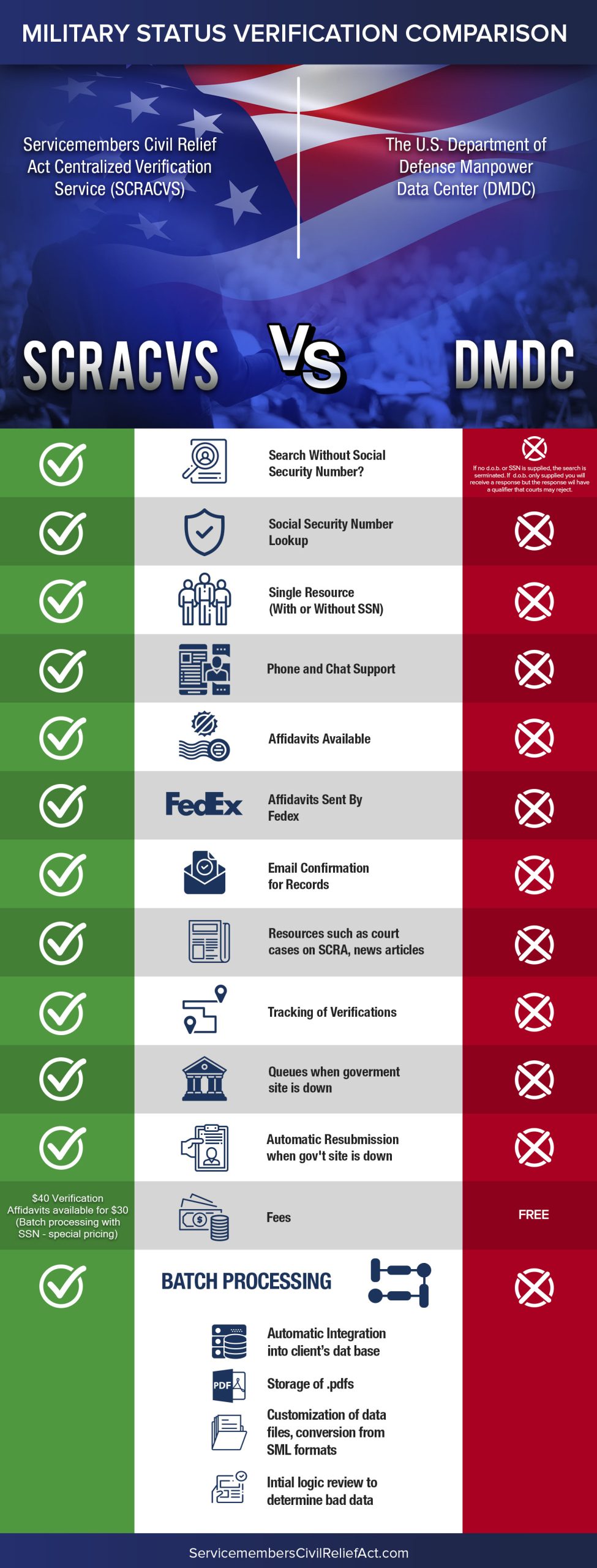
SCRACVS vs. DMDC: A Side-by-Side Comparison
|
Feature / Capability |
SCRACVS (Servicemembers Civil Relief Act Centralized Verification Service) |
DMDC (Defense Manpower Data Center) |
|---|---|---|
|
Search without Social Security Number |
✅ Yes |
❌ No |
|
Single Resource (With or Without SSN) |
✅ Yes |
❌ No |
|
Phone and Chat Support |
✅ Yes |
❌ No |
|
Court-Ready Affidavits Available |
✅ Yes |
❌ No |
|
Affidavits Sent by FedEx |
✅ Yes |
❌ No |
|
Email Confirmation for Records |
✅ Yes |
❌ No |
|
SCRA Legal Resources & Case References |
✅ Yes |
❌ No |
|
Tracking of Verification Requests |
✅ Yes |
❌ No |
|
Queues When Government Site Is Down |
✅ Yes |
❌ No |
|
Automatic Resubmission When Government Site Is Down |
✅ Yes |
❌ No |
|
Fees |
$40 Verification (Optional Affidavits for $30) |
Free |
|
✅ Yes |
❌ No |
|
|
Automatic Integration Into Client Database |
✅ Yes |
❌ No |
|
PDF Storage |
✅ Yes |
❌ No |
|
Custom Data Files & SML Conversion |
✅ Yes |
❌ No |
|
Initial Logic Review to Detect Bad Data |
✅ Yes |
❌ No |
Update Defense Manpower Data Center Records
Critical Importance of Accurate Records
Servicemembers should periodically verify that the information in the DEERS and Defense Manpower Data Center databases is accurate. Military personnel must update their records whenever a life change occurs such as a divorce, birth or death. Servicemembers should also make sure that their employment and active-duty status records, such as a call-up, re-enlistment or a move, is accurate.
If the database is muddied with inaccuracies, the effect could be serious and widespread. Servicemembers with incorrect records on file could experience interruptions in their benefits, or the benefits of their dependents. This could prove an especially difficult situation in the event the servicemember is deployed and difficult to reach for any period of time.
Loss of insurance benefits, housing, tuition assistance and much more can saddle servicemembers and their families with erroneous, staggering bills. These debts can take years to clear and rectify, if it is even possible.
Some benefits — such as TRICARE — as well as protection under the Servicemembers Civil Relief Act continue after retirement. Therefore, servicemembers should check the DEERS database to make sure their retiree status is accurate.
The DEERS database maintains information on uniformed service personnel’s active, retired and reserve members, their family members, and the DOD’s civil service personnel and contractors. However, the SCRA may not cover all these individuals. The verifications DEERS supplies also ensure accurate delivery of federal benefits. These include health and life insurance, as well as educational benefits.
SCRA Enforcement Dependent on Accuracy
Further, accurate military records are critical to proper enforcement of the Servicemembers Civil Relief Act. Foreclosure, eviction, repossession and many other actions businesses or individuals take for financial reasons may be illegal under the SCRA if the servicemember is deployed.
The law gets even more convoluted when comparing the time the servicemember entered into the contract in relation to their deployment. Generally speaking, if a servicemember is deployed after they sign a contract, the protections against enforcement can disappear.
However, different courts of law have interpreted the law differently. Does the government consider the servicemember deployed when it sends the notice? When the servicemember receives the notice? When they report for duty? Or when they leave the country? Translating this law can be a slippery slope.
Who Can Benefit from Using SCRACVS?
1. Business owners and operators
2. Banks
3. Lending institutions
4. Legal services firms
5. Storage facilities
6. Towing industry
7. Compliance for Landlords & Property Managers
8. Car repossession firms
9. Educational institutions
10. Medical institutions
11. Vehicle retailers
Taking legal action against deployed servicemembers or their families or seizing their property can result in steep fines or even jail time for violators. The DOD has been cracking down on these offenses, fining some institutions hundreds of thousands of dollars.
The easiest way to avoid this type of trouble is to get accurate military status verification before proceeding with any legal or disciplinary action. It is sometimes possible for individuals to collect accurate information on their own, but they must have the servicemember’s Social Security number. Without a correct Social Security number, the Defense Manpower Data Center does not guarantee accurate results. The DMDC includes a disclaimer with these types of verifications, saying that it does not guarantee the information is correct.
Errors in Defense Manpower Data Center Info Collection
As expected, such documents often do not hold water in court. Although many institutions require a Social Security number to do business with clients, not all do. Furthermore, errors are common when using handwritten data, so the Social Security number may then be incorrect.
Businesses needed military status verification from the Defense Manpower Data Center would do well to depend on a third-party service like SCRACVS to complete their searches for them. SCRACVS can complete a search and produce accurate results without a Social Security number, often in only 24 hours. We can also provide a military affidavit — something the Defense Manpower Data Center doesn’t do. Some jurisdictions call this a nonmilitary affidavit.
The fee is only $40 — likely a tiny percentage of the debt involved, and definitely infinitesimal compared to a fine imposed by the federal government if you do not check military status first. Institutions needing frequent, numerous, and automated verifications can get a volume discount as well, saving time and money. With SCRACVS, registration is free and we do not charge any monthly fees. Institutions and individuals only pay for the number of verifications they request, and, we offer a 100% money-back guaranty.
Before pursuing legal action against a client in default, check military records. Those who have even the slightest doubt in their ability to collect accurate information should depend on SCRACVS. For a comparison of the pros and cons of data collection methods, click below.
FREQUENTLY ASKED QUESTIONS
Defense Manpower Data Center.
The Support Office handles all DMDC and DEERS inquiries and is available at 1-800-538-9552
The Defense Manpower Data Center is an office within the United States Department of Defense. It is the hub for information and support for all human resource issues arising within the Defense Department. The available information includes personnel information (including after termination of engagement and for families of servicemembers), benefits, and entitlements.
The Defense Enrollment Eligibility Reporting System (DEERS) is a record system maintained by the DMDC at the U.S. Department of Defense. Its records include servicemembers, retirees, dependents, some active contractors who may be entitled to benefits.
The DMDC is data center with military records (but it isn’t, of course, its own government).
The DMDC’s role is crucial. With 7 reporting agencies (Army, Navy, etc.), it consolidates the information on personnel and coordinates inquiries.
Most SCRACVS military status verifications are completed the same day, often within minutes to a few hours. Turnaround time may vary slightly based on the completeness of the information provided and whether additional verification steps are required. For time-sensitive actions such as evictions, repossessions, or default judgments, SCRACVS is structured to deliver results fast enough to avoid legal delays while still maintaining accuracy and compliance.
Yes. SCRACVS allows military status verification without a Social Security Number. Searches can be performed using a combination of name, date of birth, and other identifying details. This is especially important for landlords, lenders, and attorneys who are legally restricted from requesting or storing SSNs. While providing more data can improve match confidence, an SSN is not required to obtain a valid SCRA verification through SCRACVS.
SCRA compliance verification is required across multiple industries where legal or financial action may affect an individual. Common industries include property management and real estate, mortgage and auto lending, collections and debt recovery, law firms, courts, and financial services. Any business that may file an eviction, repossess property, seek a default judgment, or enforce a financial obligation must verify whether SCRA protections apply before proceeding.
After completing a military status verification through SCRACVS, you can request a court-ready military affidavit directly from the platform. The affidavit is generated using verified Department of Defense data and includes the required statements courts expect under the Servicemembers Civil Relief Act. These affidavits are commonly used in eviction filings, foreclosure actions, and civil lawsuits where proof of military status is legally required.
Defense Manpower Data Center (DMDC) provides a free public lookup tool, but it places responsibility for accuracy, interpretation, and documentation entirely on the user. SCRACVS, on the other hand, adds structured verification workflows, search records, expert handling, and court-usable affidavits. Businesses and legal professionals use SCRACVS to reduce risk, avoid filing errors, and ensure compliance when outcomes have legal consequences.
Yes. SCRACVS verifications and affidavits are legally accepted in courts across the United States. They are generated using official Department of Defense data and formatted to meet judicial requirements for SCRA compliance. Courts rely on properly documented military status determinations before allowing actions such as evictions, default judgments, or repossessions to proceed. Using SCRACVS helps ensure that filings are not rejected due to incomplete or improper verification.
SCRACVS pricing is transparent and per-verification, with no subscriptions or hidden fees — you simply pay for each name you verify.
Base Verification – $40: Court-ready active duty status confirmation delivered by email.
Optional Affidavit – + $30: Notarized paper affidavit with raised seal for court filings.
Optional FedEx Shipping – + $46: Trackable delivery of the affidavit where needed.
This structure makes SCRACVS cost-effective for landlords, lenders, and attorneys who need official verification and legal affidavits rather than free lookup results.
In many cases, no. Defense Manpower Data Center provides an informational military status lookup, but it does not automatically satisfy court requirements. Courts typically require a properly worded military affidavit stating whether a defendant is on active duty or not. A DMDC search result alone often lacks sworn language, certification, and accountability, which means it may be insufficient for filings such as evictions, default judgments, or foreclosures.
You should use SCRACVS when the verification will be used in any legal or court-related action. This includes evictions, repossessions, foreclosures, debt collection lawsuits, and default judgments. SCRACVS is designed for situations where accuracy, documentation, and legal acceptance matter, providing verified results and court-ready affidavits rather than placing the burden of interpretation on the user.
Relying solely on DMDC can expose you to significant legal risk. If a DMDC result is misread, outdated, or incomplete, a court may determine that proper SCRA compliance was not met. This can lead to dismissed cases, vacated judgments, fines, sanctions, or case delays. Because DMDC places responsibility on the user, errors fall on the filer—not the government tool.
No. DMDC does not provide sworn affidavits or notarized statements. It only supplies search results. Courts usually require a formal military affidavit that clearly states whether SCRA protections apply and is suitable for filing. This affidavit must often include specific legal language and accountability that DMDC does not offer.
Yes. Judges can and do reject DMDC verification when it does not meet local or federal court requirements. Common issues include a lack of sworn language, missing verification dates, unclear conclusions, or improper formatting. When a filing relies on DMDC alone, courts may require the case to be refiled with proper documentation, causing delays and added legal costs.