
How to Find Out if Someone Is in the Military: 6 Ways to Verify Service
A name on a lease. A story that does not quite add up. A borrower who tells you he cannot be taken to court right now because he is deployed. In each case, you need the same thing, and fast: a reliable way to find out if someone is in the military. Active duty status you can confirm in minutes. A full service history you usually cannot, and knowing that difference saves you time, money, and legal exposure.
TL;DR: You can confirm whether someone is on active duty for free using the Defense Manpower Data Center, or get a court-recognized report through SCRACVS active duty verification using only a name and date of birth. Full service records, including dates, duty stations, and discharge details, stay private and require the person’s consent or a DD Form 214. Below are six ways to check, what each one proves, and which fits your situation.
What a “Service Member” Is and What You Can Legally Check
A service member is anyone currently serving on active duty in the Army, Navy, Air Force, Marine Corps, Space Force, or Coast Guard, including many Reserve and National Guard members on active orders. That definition matters because the law treats two kinds of information very differently.
Current active duty status is close to public. Anyone can confirm it through official federal systems using basic identifiers. This is the check a landlord, lender, or attorney runs before filing a default judgment, starting a repossession, or moving on a foreclosure, because the Servicemembers Civil Relief Act (SCRA) gives active members specific protections.
Service dates, rank history, duty stations, medical files, and discharge type stay protected under federal privacy law. You reach those only with the person’s written consent, or as the veteran, their next of kin, or an authorized representative. Sort out which one you actually need before you start, because it decides every step that follows.
Can You Look Up if Someone Is or Was in the Military?
Yes, and the honest answer has two layers. Confirming that someone is on active duty right now is straightforward and often free. Knowing how to find out if someone was in the military years ago, or pulling the details of how they served, takes more time and usually more permission.
Your use case sets the bar. An employer checking a job applicant’s claim typically needs one thing: a yes or no on service, maybe the branch. A funeral home arranging burial benefits, or a family member settling an estate, needs the full record from the archives. Match the method to the outcome you need, and you avoid wasted weeks waiting on a request that was never going to answer your question.
6 Ways to Find Out if Someone Is in the Military
Start with the method that fits your purpose and your timeline. The list runs from the fastest, most practical options for everyday verification down to the slower, records deep dives.
1. SCRACVS (Military Verification Without an SSN)
The Servicemembers Civil Relief Act Centralized Verification Service confirms a person’s active duty status and hands you a document you can actually use. You submit a name and date of birth. No Social Security Number and no military email are required. Results usually land by email within 24 hours.
What sets it apart is the paperwork. You can add a notarized affidavit of non-military service or a formal report that courts and lenders accept. That makes it the go-to choice for attorneys, landlords, and financial institutions who need proof, not just a screenshot. It pulls from the same federal source the government uses, so the data holds up.
Best for: legal filings, SCRA compliance, rental and loan decisions, any situation where you may have to defend the check later.
2. Defense Manpower Data Center (DMDC)
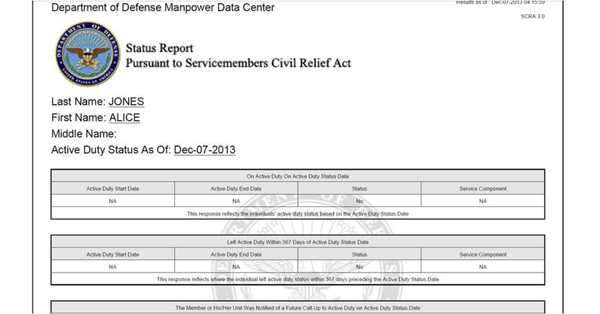
The Defense Manpower Data Center’s (DMDC) military verification service is a free tool on the website that tells you whether a person is currently on active duty and which branch they serve. It reads from the official federal personnel system in real time, which makes it a quick military verification.
The limits are real, though. Without a Social Security Number, the system flags that the result may not be exact. It returns current status only, so it says nothing about past service, service dates, or discharge. And the output carries a disclaimer rather than a formal, signed document, which is why it falls short for court or compliance work.
Best for: a fast, informal gut check when nothing legal rides on the answer.
3. National Archives and the NPRC
The National Personnel Records Center, part of the National Archives military records system, holds the official federal military service records. This is where past service lives: service dates, branch, rank, and the DD Form 214 that documents discharge.
You can file a service record request online through the eVetRecs portal, or mail Standard Form 180 to the center. Access stays limited to the veteran, the next of kin, or an authorized representative, and full public access only opens 62 years after separation. Plan on four to eight weeks for a reply.
Best for: confirming that someone served years ago, verifying a discharge, or gathering documents for benefits and family records.
4. Military Records Search by Name
Searching by name alone is the option most people reach for first, and the one that disappoints most often. Genealogy sites, archives.gov research tools, and paid lookup services can surface older or historical records, and some World War II-era files are searchable this way. For living military personnel, a name by itself rarely helps you locate military records that are actually usable.
Here is the practical truth: to get a real match, you almost always need a date of birth, and for anything beyond basic status you need consent. Free name searches work best for historical and genealogy research. For a current, defensible answer about a living person, pair the name with a date of birth and run it through an official verification instead.
Best for: historical research, genealogy, and tracing older service that predates modern privacy limits.
5. Freedom of Information Act (FOIA) Request
A FOIA request lets you verify military service by asking a branch for the limited, non-confidential parts of a service record. There is no special form. You write a short letter or email to the FOIA office of the relevant branch and state what you want.
Include the person’s full name, date of birth, and branch, then ask for confirmation of service dates, rank, and branch under the Freedom of Information Act. Something as plain as “I request confirmation of the military service of [Full Name] under the FOIA, including service dates, rank, and discharge type” does the job. Expect four to eight weeks for a response.
Best for: research or background validation when you want an official reply straight from the branch and time is not tight.
6. Ask for the DD Form 214 Directly
The DD Form 214, the Certificate of Release or Discharge from Active Duty, is the single document that proves someone served. It lists service dates, branch, rank, discharge type, and reenlistment code. If a person can hand you a clean copy, you have strong evidence in one page.
Check it before you trust it. Look for consistent formatting, official letterhead, and details that line up. Misspellings, mismatched dates, or altered text point to a forgery, and when in doubt, you can ask the National Archives to validate the copy. Only the veteran holds the original, so anyone else needs written consent to share it.
Best for: employment verification, benefits, and family records where the person cooperates and can produce the form.
How to Verify Military Service for Legal or Business Use
When money or a court is involved, the method you pick has to survive scrutiny. A free status check is fine for peace of mind. It falls apart the moment a judge, an auditor, or opposing counsel asks for proof.
For legal and business decisions, use a source that produces a signed, dated document. An SCRACVS affidavit and a verified DD Form 214 both clear that bar. If you are a landlord about to file, a lender about to repossess, or an attorney about to move for a default judgment, get the documented version first. The cost of a formal check is trivial next to the cost of violating the SCRA, which can include reopened judgments and financial penalties.
How to Spot a Military Imposter or Romance Scammer
Fake service claims are not rare, and they are expensive. Romance scams cost Americans about $1.14 billion in reported losses in 2023, according to the Federal Trade Commission, and a favorite script is the deployed soldier who cannot video call, cannot access his pay, and needs you to wire money.
Watch for a familiar set of tells. A real service member can name a unit and a chain of command. A scammer dodges specifics, then pivots to a money request, often gift cards or a wire transfer. Uniform photos that do not match the stated rank, dramatic overseas stories, and any claim of being unable to touch his own bank account while deployed all deserve suspicion.
Two rules protect you. Never send money or share your bank details, no matter how convincing the story. And confirm the claim through an official channel before you believe any of it. Falsely claiming military service for personal gain is a federal offense under the Stolen Valor Act of 2013, and a two-minute verification exposes it fast.
Privacy and the Law When You Look Up Service Records
Verification has boundaries, and staying inside them keeps you clean. Active duty status is checkable through official systems, but complete personnel files are protected. Medical records, disciplinary history, and personal contact details stay sealed to everyone except the veteran and their next of kin.
Respect the consent rules, and you have nothing to worry about. Reach for records you are not entitled to, and you create your own legal problem. The same law that protects genuine members, the Stolen Valor Act among them, exists to keep the record honest on both sides. Verify what you need, document it properly, and leave the rest alone.
Verification Options Compared
| Method | Who Can Use It | What It Shows | Time | Best For |
| SCRACVS | Public or legal users | Active duty status, affidavit of non-military service | About 24 hours | Legal filings, landlord and lender verification |
| DMDC | Public | Current active duty status and branch | Instant | Quick, informal checks |
| National Archives / NPRC | Veterans or next of kin | Full records, including DD Form 214 | 4 to 8 weeks | History and discharge verification |
| FOIA | Public | Limited, non-confidential service details | 4 to 8 weeks | Research and background validation |
| DD Form 214 from the person | With consent | Verified service and discharge details | Varies | Employment and benefits |
| Records search by name | Public | Informal or historical details | Immediate | Genealogy and older service |
Choosing the Right Way to Verify Military Service
The method that fits depends on one question: will you ever have to prove the answer? For a quick, low-stakes check, the free DMDC tool does the job. For genealogy or old service, the archives are your source. But the moment a lease, a loan, or a court filing rides on it, a casual check becomes a liability, and you need a document that holds up.
That is the gap SCRACVS fills. You get a court-recognized verification within 24 hours, with no Social Security Number required and an affidavit ready for filing, all drawn from official federal data. If you are a landlord, lender, employer, or attorney who needs to confirm active duty status before you act, run the check through SCRACVS and keep your decision accurate, compliant, and fully documented.
FAQs
How can I verify someone’s military service?
Confirm current active duty status for free through the Defense Manpower Data Center, or get a documented result from SCRACVS using a name and date of birth. For past service and discharge details, request records from the National Archives or ask the person for their DD Form 214. Match the method to whether you need a quick answer or legal proof.
How do I find out if someone served in the military?
To find past service, look to the National Personnel Records Center, which holds these records. Submit a request through eVetRecs or mail Standard Form 180. Access is limited to the veteran, next of kin, or an authorized representative, and files are open to the public 62 years after separation. The simplest route is often to ask the person directly for their DD Form 214.
Is military service a public record?
Current active duty military status is publicly checkable through the DMDC. Full personnel files are not. Service dates, medical records, and disciplinary history stay private and require the member’s consent or next of kin authorization through the NPRC.
How does USAA verify military service?
USAA and similar organizations confirm eligibility through official Department of Defense data, typically the same federal personnel records that back the DMDC and SCRACVS. Members verify their own status by providing identifying details or documents like a DD Form 214, which the organization checks against government records.
Can you look up military records by name for free?
For older and historical records, yes, through archives.gov tools and some genealogy databases. For a living service member, a name alone rarely returns a usable result. You generally need a date of birth, and for anything beyond basic status you need the person’s consent.
Is lying about being in the military illegal?
Yes. Under the Stolen Valor Act of 2013, falsely claiming military service or decorations for personal or financial gain is a federal offense that can carry fines or imprisonment.
How do I verify my own service for a job or discount?
Use your DD Form 214, a VA identification card, or a verification letter from SCRACVS. Each confirms your service dates, branch, and status, which is enough for employers, lenders, and discount programs.